Kirjad Austinist · 30 October 2026
Letter four: The man I made up
I arrived at UT Austin’s School of Social Work as a Fulbright visiting student researcher with a keycard, a desk and a plan: to understand how people in America get help with their mental health.
The desk is in a corner on the fourth floor, by a big window. It’s quiet up here. People sit tucked away in their offices, each getting on with their own work, and I’ve been getting on with mine: a screen, a few sheets of notes, and the window whenever the screen gets too much. I’ve been to plenty of meetings across campus, but this corner is where my brain has spent three months slowly baking.

In August I did what a visiting researcher does. I read everything, drew boxes and arrows, and wrote emails to the people who know how it all works: a suicide prevention coalition, a mental health institute on my own campus, an implementation science institute in Houston. For the first three weeks or so, not much came back. Well, it was August. Half of American academia was on holiday and the other half was getting ready for the semester.
Nobody was ignoring me. People here are busy and get a staggering amount of email, and a message from a stranger joins the pile, probably labelled as later/someday. A message from someone they know gets read, though. My host, Professor Diana DiNitto, sent an email to one person at Integral Care, Travis County’s public mental health provider, and within a day I was introduced to their suicide prevention leads. Turns out that doors here open the same way they do at home: from the inside. So I’ve mostly stopped writing to strangers and started asking the people I know who they know.
Once the semester started, things moved. Jaime, a colleague who seems to know everyone, walked me around the building and introduced me to half of it. The Texas Institute for Excellence in Mental Health, the one on my own campus, got back to me, and I met people there. A psychology student read the school’s profile of me, found these letters and offered to help with my research, so the letters have already found me a volunteer. By October I had spoken with or written to more than twenty people.
Things were moving. The trouble was that I was moving in every direction.
Almost everyone I met asked the same polite question: so what exactly are you interested in? Community-based interventions, I’d say. Depression, mental health support, suicide prevention. Fine, they’d say, and tell me about their part of the field. Some work with young people, some with people who have lost their homes, some with people who use drugs. Every part made sense on its own. Together they were everywhere, and nowhere.
And everything seemed to start with the same question: does the person have health insurance? That makes a big difference to which services they can get, and what they have to pay. So I asked several people to explain, simply, how health insurance works here. Nobody could, and they were honest about why: they don’t fully understand it either.
I sat in my corner and read some more. Strategies, action plans, lists of services. I don’t remember the exact day, but I remember the window. Tired of the screen, I looked down at the street. It’s a campus, so there were plenty of students, but people of every age too, all on their way somewhere. And I wondered how I was supposed to understand what help any of them could get, and how.
Then it occurred to me that I didn’t have to understand all of it at once. I could start with one person.
There was a man walking down the street. I had no idea where he was going. But he might, right then, need help with his mental health. If he did, where would he go? Who would he talk to? From there, it started rolling. I felt I might be onto something.
Why a man, and not one of the students? Partly because I am one, and forty years of fieldwork should count for something. Partly because I spent many years as a school psychologist and a teacher, and I know what support young people have, at least in Estonia: almost every school has, or should have, a psychologist and a social worker. Mostly because of a number I’ve known for years. More than four in five people who die by suicide in Estonia are men, and the proportion in Texas, turns out, is almost identical. The overall trends have moved in opposite directions since 2001, down in Estonia and up in Texas, but the gender imbalance is strikingly similar. (More numbers at the end, for the nerds.)
One Thursday in early October I sat down and did something I hadn’t done in years. I gave the man from the window a name, a job and a life.
Let me introduce you to Mark. He is 47 and has run building sites for the same Austin firm for eleven years. He is the one who fixes problems. He has been married for twenty years, has two teenagers and a house in Pflugerville, and his wife runs their social life. Twice a year he goes hunting with his brother-in-law. Friends of his own, not really.
Mark is a persona: a made-up but plausible person. I put him together from everything I’d been reading about American and Texan lives. I’ve used personas before, in other roles, the way designers use them to keep in mind who they’re building for. The point is to have someone specific enough to ask specific questions. Which door would Mark walk through? Who would be behind it?
Building him taught me something straight away. Remember the insurance nobody could explain? For a man like Mark, how much help he can get depends a lot on whether he still has a job, because the job usually brings the insurance.
Over nine months, his life comes apart in a very ordinary way. He sleeps four or five hours a night, drinks a bit more than he used to, and sees his doctor about his back. In construction a bad back is part of the job, so he leaves with a muscle relaxant, while the card for his employer’s free counselling line sits in the site trailer.
Then his wife asks him to leave and files for divorce, and he finds a family lawyer. Mark doesn’t just lose a marriage. His wife was his calendar, his dinner invitations, his in-laws and his hunting trips, which stop because they came through her family. She would also have been the first to notice he wasn’t sleeping. When the marriage ends, the whole network goes with it, all crashing down, on the same day.
Then the firm he works for lays off a third of its staff. His health insurance came with the job. Keeping it is possible, but expensive, and he has more pressing bills, so he lets it go and registers with the state as a job seeker. By month seven he is sleeping late, drinking every day and not picking up the phone. His teenage son notices more than anyone and has no idea how to help or who to call.
Count the doors he walks through: a doctor, a lawyer, a mediator, the unemployment office. Each meets him for a different reason: a bad back, a divorce, a lost job. Any of them might notice that something else is wrong. In the version I wrote, nobody puts it together, and the first time anyone asks how he really is, it’s in a crisis, nine months after the first sign.
Mark is made up. But people like him do see doctors. In one large American study of nearly 5,900 people who died by suicide, 83 percent had seen a health care provider in the year before, about half in the last four weeks, and roughly half had no recorded mental health diagnosis.
In October I finally had my video call with Integral Care, with someone who leads two of their teams. One works in a hospital or clinic. The other drives out to wherever the person is. They work within a framework called Zero Suicide. Once someone is in their care, they call every seven days to ask how it has been, whether anything has changed, and whether the plan needs adjusting.
Every seven days.
Mark goes nine months without anyone really asking once.
Their work starts when someone reaches them, usually through a referral or a call to a helpline, and from what I heard they are good at it. But when I said I was turning towards men, there wasn’t much to add. Men aren’t a separate group in their work, and the long stretch before a crisis is mostly outside what they do anyway. So, I asked myself, whose job are those nine months?
Maybe it doesn’t have to be anybody’s job. I came here asking about services: what exists, who provides it, who pays for it, who qualifies. Mark turned that into a different question. Most of what kept him going was never part of the (service) system: the crew, the hunting trips, his kids. Nobody would call any of it mental health support, but those are the places where someone might have noticed he’d gone quiet, or stopped turning up.
And this is what has always interested me most: community. Not programmes or interventions, per se, but people being part of each other’s lives. Services matter, and they have to be there. But whether someone stays steady or falls into a hole also depends on the ordinary weeks, when nobody is a patient, nobody has a diagnosis, and nobody is thinking about an intervention. Who notices? Who shows up?
I’ve decided that’s what I’ll spend the rest of my time here on. I’ll keep an eye on workplaces and on how men find professional help, but most of my time goes to the places where men already gather.
In the last letter I mentioned the Thursday bike ride, where people get together to ride and nobody calls it mental health. What happens when someone stops turning up? Does anybody notice? And if they do, what happens next? I’m not suggesting that cycling organisers, pastors or jiu-jitsu coaches should become therapists. I want to know what already happens in these groups, and what the people running them might find useful.
At the start of November I’m spending three days at the American Public Health Association’s annual meeting in San Antonio. Researchers and practitioners from across the country will be there, and I’ll be listening for anything that reaches people outside clinics, and hoping to meet people who have already tried some of this.
After that, I’m leaving my corner on the fourth floor to collect some real stories. I want to go into the rooms where men already gather to do something together: an early-morning workout group, a church, a jiu-jitsu gym. I want to talk to the people who keep them going, and see whether anyone notices when someone starts to struggle. And I want to start asking the same question at home in Estonia, where I’ve spent much of my working life on community mental health.
Three months in, I still can’t tell you how American mental health care works. I’m not sure anyone can. But now I at least know which question I’m here for, and I think I’ve done enough reading for a while.
If you know a group like that, in Austin or at home, and the person who keeps it going, I’d love an introduction. Warm ones work best, as we’ve established.
P.S. For the nerds. I wanted to compare Estonia and Texas because one is home and the other is where I’m spending this year. Here’s how their overall suicide rates have changed since 2001.
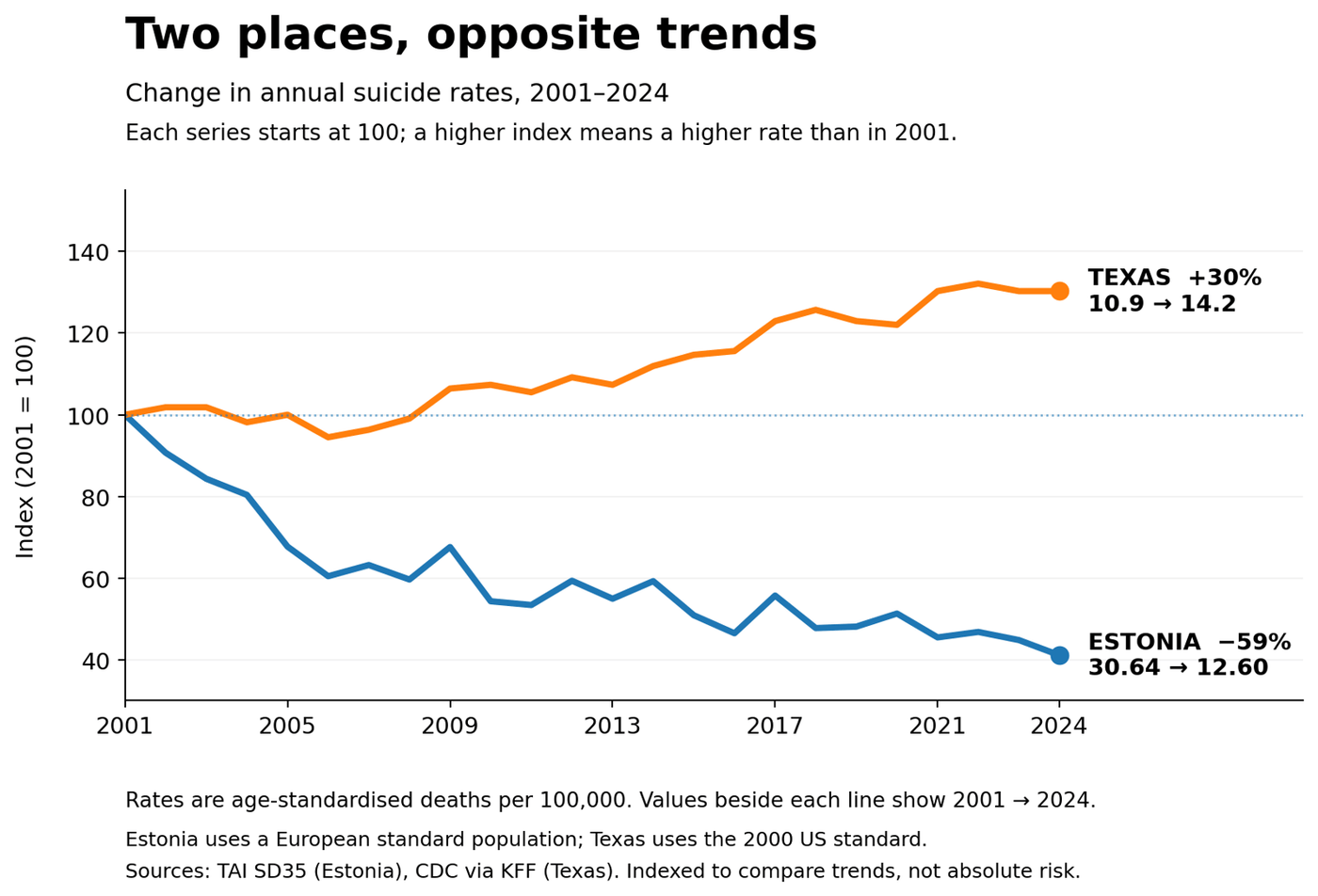
Between 2001 and 2024, Estonia’s age-standardised suicide rate fell by 59%, while Texas’s rose by 30%. Both lines start at 100 in 2001, so they show the change in each place rather than which one has the higher rate. Estonia and Texas use different standard populations (European and US, respectively), making direct comparisons of their rate levels misleading.
The lines include men and women together. In 2024, men accounted for 81% of suicide deaths in Estonia and 80% in Texas. Between 2023 and 2024, Estonia had 17 fewer suicide deaths; sixteen of those were women.
Sources: Estonia’s TAI/ERSI suicide statistics and TAI annual database (SD35); Texas CDC data via KFF; the US healthcare-contact study, which followed people enrolled in participating healthcare systems rather than the whole US population.
If any of this is close to home: in Estonia, call 112 in an emergency or the 24-hour crisis line 116 006. In the US, call or text 988.
The newsletter
Kirjad Austinist
Letters like this one, in your inbox when there's something worth saying.